Introduction
Healthcare is becoming increasingly digital, and Electronic Medical Records (EMR) are one of the most important developments in modern healthcare. Traditionally, hospitals maintained patient information in paper files containing case sheets, investigation reports, prescriptions, nursing notes, discharge summaries, and other clinical documents. While paper records continue to have a role in some healthcare settings, electronic records provide a more organized, accessible, and efficient way to manage patient information.
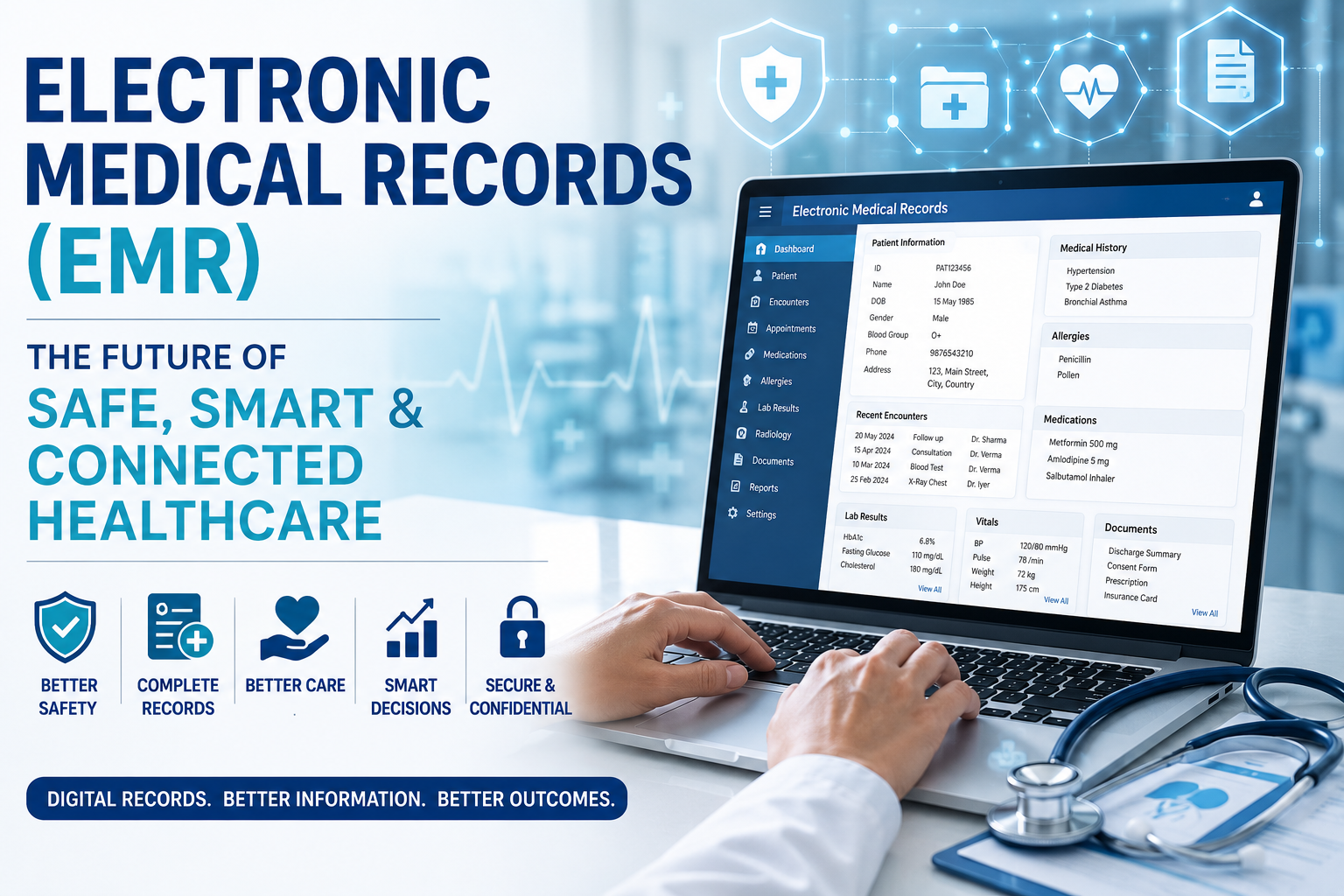
An Electronic Medical Record is a digital version of a patient’s medical information maintained by a healthcare facility. It may include patient demographics, medical history, diagnosis, allergies, medications, laboratory reports, radiology reports, treatment details, progress notes, nursing documentation, discharge summaries, and other relevant healthcare information.
For hospitals working toward quality improvement, patient safety, accreditation, and better healthcare delivery, an effective EMR system can become an important part of the overall healthcare infrastructure.
What Is an Electronic Medical Record?
An Electronic Medical Record is a computerized record containing information about a patient’s healthcare journey within a healthcare organization.
Depending on the system used by a hospital, an EMR may contain:
- Patient registration and demographic information
- Unique patient identification number
- Medical and surgical history
- Allergies and adverse drug reactions
- Diagnosis and clinical findings
- Doctor’s orders and progress notes
- Medication records
- Nursing assessment and nursing notes
- Laboratory investigation reports
- Radiology and imaging reports
- Vital signs and monitoring charts
- Operative and procedure notes
- Consent documentation
- Discharge summary
- Follow-up information
- Billing and administrative information
The objective is not simply to replace paper with computers. The real objective is to make healthcare information more accurate, accessible, secure, and useful for patient care and decision-making.
Why Are Electronic Medical Records Important?
1. Better Patient Safety
Patient safety is one of the most important reasons for implementing EMR systems.
An electronic record can help healthcare professionals access important information such as allergies, previous diagnoses, medications, investigation results, and clinical history.
For example, if a patient has a documented drug allergy, the information can be made visible to authorized healthcare professionals before medication is prescribed or administered.
A well-designed EMR can therefore support safer clinical decisions and reduce preventable documentation and communication errors.
2. Quick Access to Patient Information
In a paper-based system, healthcare professionals may need to search through multiple pages or contact the Medical Records Department to locate information.
With an EMR, authorized users can access relevant information quickly according to their role and permissions.
Doctors can review previous clinical notes, nurses can access nursing documentation, and authorized departments can retrieve investigation reports without physically moving a patient file from one department to another.
This can save valuable time, particularly in emergency and critical-care situations.
3. Improved Documentation
Good documentation is essential for continuity of care.
EMR systems can provide structured formats for recording:
- Patient assessment
- Diagnosis
- Treatment
- Medication
- Nursing care
- Investigations
- Procedures
- Clinical progress
- Discharge information
Mandatory fields, alerts, templates, date and time stamps, and electronic authentication can help improve the completeness and consistency of documentation.
However, technology alone does not guarantee good documentation. Staff must be properly trained and hospital policies must clearly define documentation requirements.
4. Better Communication Between Healthcare Professionals
Healthcare delivery involves multiple professionals, including doctors, nurses, laboratory staff, pharmacists, radiology personnel, medical record professionals, and administrative teams.
EMR systems can provide a common source of patient information for authorized users.
For example, when a laboratory report becomes available electronically, the treating team can review the result without waiting for a physical report to reach the patient’s file.
Better information sharing can support continuity of care and effective communication.
5. Reduction in Paperwork
Paper records require significant resources for printing, filing, indexing, storage, transportation, retrieval, and preservation.
Hospitals with large patient volumes may require substantial physical storage space.
Electronic records can reduce dependence on physical storage and make document retrieval easier. They can also reduce unnecessary duplication of documents and improve record organization.
However, hospitals should have appropriate backup, downtime, retention, and disaster-recovery arrangements because digital information must remain available and protected.
6. Support for Medication Safety
Medication errors can occur because of incomplete information, illegible handwriting, incorrect doses, communication problems, or lack of awareness of allergies and previous medication use.
An EMR can support medication safety through features such as:
- Electronic medication orders
- Allergy documentation
- Medication history
- Dose and frequency fields
- Medication administration records
- Alerts and reminders
- Documentation of medication administration
When integrated appropriately, electronic systems can help healthcare professionals follow safer medication practices.
7. Easy Retrieval for Medical Records and Audits
For Medical Records Departments, EMR systems can significantly improve record retrieval and review.
Authorized staff can search records using patient identifiers, admission numbers, dates, departments, or other available parameters.
This can support:
- Medical record audits
- Clinical audits
- Quality indicators
- Mortality reviews
- Infection-control monitoring
- Documentation audits
- Patient safety reviews
- Accreditation preparation
- Statistical reporting
For hospitals focusing on NABH and continuous quality improvement, organized electronic documentation can make data collection and audit processes more efficient.
8. Supports Hospital Quality Improvement
Modern healthcare requires hospitals to continuously monitor their performance.
EMR systems can help hospitals collect data for quality indicators such as:
- Patient waiting time
- Length of stay
- Readmission
- Medication errors
- Patient falls
- Infection-related indicators
- Mortality
- Discharge documentation
- Patient complaints
- Clinical outcomes
When reliable data are available, hospital management can identify problems, analyze trends, implement corrective actions, and monitor improvement.
This supports a data-driven approach to healthcare quality management.
9. Improved Data and Reporting
Healthcare organizations generate a large amount of information every day.
EMR systems can help convert patient records into useful operational and clinical data.
Hospital management can use this information for dashboards, reports, resource planning, quality monitoring, and decision-making.
For example, a hospital may analyze patient volumes by department, diagnosis patterns, average length of stay, bed occupancy, or investigation utilization.
This is where healthcare analytics and business analytics become particularly valuable.
10. Better Continuity of Care
Patients may receive care from different departments and healthcare professionals during the same hospitalization.
A well-maintained EMR allows relevant information to follow the patient throughout the care process.
From registration to consultation, investigation, treatment, nursing care, procedure, discharge, and follow-up, information can be connected within the patient’s electronic record.
This can reduce information gaps and support continuity of care.
11. Security and Confidentiality
Patient medical information is sensitive and must be protected.
An EMR system should include appropriate security controls such as:
- User authentication
- Role-based access
- Password management
- Access permissions
- Audit trails
- Data backup
- Secure data transmission
- Controlled information sharing
Healthcare organizations should establish clear policies regarding who can access patient information, what information they can access, and when access is permitted.
Staff should also understand that having electronic access does not mean unrestricted access.
12. Challenges of Electronic Medical Records
Although EMR systems provide many benefits, implementation also presents challenges.
Common challenges include:
- Initial implementation cost
- Staff resistance to change
- Training requirements
- System downtime
- Cybersecurity risks
- Data privacy concerns
- Poor system design
- Duplicate patient records
- Incorrect data entry
- Interoperability problems
- Dependence on technology
Therefore, successful EMR implementation requires more than purchasing software.
Hospitals need leadership support, staff training, standard procedures, technical support, data-security controls, monitoring, and continuous improvement.
Role of Medical Records Professionals
Medical Records Officers and Medical Records Departments have an important role in the successful implementation and management of EMR systems.
Their responsibilities may include:
- Ensuring accurate patient identification
- Monitoring documentation completeness
- Supporting medical record audits
- Maintaining data quality
- Managing record retention requirements
- Supporting confidentiality and access controls
- Identifying documentation deficiencies
- Coordinating with clinical and IT departments
- Supporting quality and accreditation requirements
- Generating reliable medical record statistics
The role of the Medical Records Department is therefore evolving from traditional file management toward health information management and data quality management.
The Future of Electronic Medical Records
The future of EMR is moving toward more connected and intelligent healthcare systems.
Emerging technologies such as Artificial Intelligence, clinical decision support, healthcare analytics, automation, interoperability, digital health platforms, and predictive analytics can further improve how healthcare information is used.
However, technology should always support—not replace—the clinical judgment of qualified healthcare professionals.
The ultimate objective should remain the same:
Right information + Right patient + Right professional + Right time = Safer Healthcare.
Conclusion
Electronic Medical Records are much more than digital versions of paper files. They are an important component of modern healthcare information management.
A properly implemented EMR can improve patient safety, documentation, communication, accessibility, medication management, quality monitoring, data analysis, and continuity of care.
For hospitals, the goal should not simply be to become paperless. The real goal should be to become safer, more efficient, data-driven, patient-centered, and quality-focused.
As healthcare continues to evolve, hospitals that effectively manage electronic health information will be better positioned to improve clinical outcomes, strengthen quality systems, support accreditation requirements, and provide safer healthcare services.
Final Thought
Electronic Medical Records are not just about technology—they are about transforming healthcare information into better decisions, better coordination, and better patient care.
Safe Data. Better Decisions. Quality Care.