
NABH 6th Edition Human Resource Management (HRM): Complete Guide with Audit Checklist & Compliance Requirements
Introduction
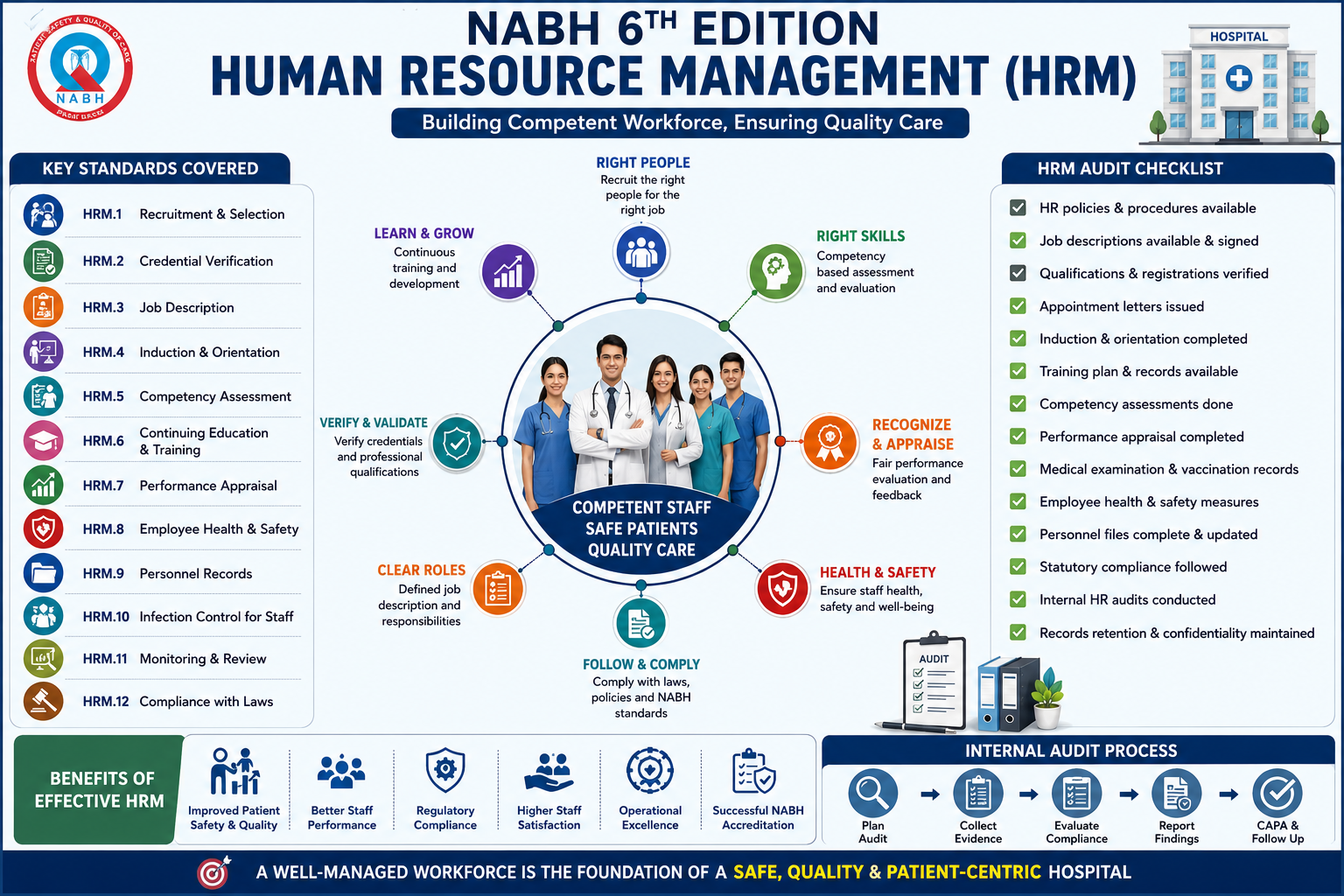
Human Resource Management (HRM) is one of the most important chapters in the NABH 6th Edition Accreditation Standards. A hospital’s quality of care depends not only on infrastructure and technology but also on the competency, training, and performance of its healthcare professionals.
The HRM chapter ensures that every employee—from doctors and nurses to technicians and housekeeping staff—is appropriately qualified, trained, competent, and regularly evaluated. Effective HR management directly contributes to patient safety, quality improvement, legal compliance, and organizational excellence.
This comprehensive guide explains the NABH HRM chapter, required documentation, audit checklist, internal audit process, and best practices for hospitals.
Objectives of NABH HRM
The HRM standards aim to ensure that hospitals:
- Recruit qualified healthcare professionals.
- Verify credentials and licenses.
- Define job responsibilities clearly.
- Conduct induction and orientation programs.
- Assess competency regularly.
- Provide continuous education and training.
- Maintain employee health and safety.
- Monitor staff performance.
- Maintain complete personnel records.
Major Components of the NABH HRM Chapter
1. Recruitment and Selection
Hospitals should have a documented recruitment policy that defines eligibility criteria, qualification requirements, experience, interview process, reference verification, and appointment procedures.
Required Documents
- Recruitment Policy
- Interview Assessment Form
- Appointment Letter
- Qualification Certificates
- Experience Certificates
- Identity Proof
- License/Registration Certificate
2. Credential Verification
All professional qualifications must be verified before appointment.
Verification includes:
- Educational qualification
- Professional registration
- Previous experience
- Government identification
- Background verification
3. Job Description
Every employee should receive a written Job Description that includes:
- Duties
- Responsibilities
- Reporting authority
- Required qualifications
- Scope of work
- Accountability
Employees should acknowledge receipt of their job description.
4. Induction & Orientation Training
Every newly appointed employee should undergo orientation before starting work.
The induction program should include:
- Hospital vision and mission
- Patient safety goals
- Infection prevention and control
- Fire safety
- Biomedical waste management
- Disaster management
- Medical record documentation
- NABH awareness
- Patient rights
- Code of conduct
Maintain attendance records and training evaluations.
5. Competency Assessment
Competency must be evaluated periodically.
Assessment methods include:
- Direct observation
- Practical demonstration
- Skill checklist
- Written examination
- Departmental evaluation
- Performance monitoring
Competency records should be documented.
6. Continuing Education
Hospitals should conduct regular training on:
- NABH Standards
- CPR/BLS
- Fire Safety
- Infection Control
- Biomedical Waste Management
- Medication Safety
- Documentation
- Patient Safety Goals
Maintain an annual training calendar.
7. Performance Appraisal
Each employee should undergo periodic performance evaluation based on:
- Attendance
- Clinical competency
- Discipline
- Communication
- Teamwork
- Training participation
- Patient feedback
- Departmental objectives
Document performance appraisal records.
8. Employee Health & Safety
Hospitals should protect employees through:
- Pre-employment medical examination
- Annual health check-up
- Vaccination
- Needle-stick injury protocol
- Occupational health monitoring
- PPE availability
- Mental well-being support
Maintain confidential health records.
9. Personnel File Checklist
Every personnel file should include:
- Application Form
- Resume
- Qualification Certificates
- Experience Certificates
- Aadhaar/PAN
- Appointment Letter
- Joining Report
- Job Description
- Confidentiality Agreement
- Police Verification (if applicable)
- Registration Certificate
- Training Records
- Competency Assessment
- Health Check-up Reports
- Vaccination Records
- Performance Appraisal
- Leave Records
- Promotion Records
- Resignation/Relieving Documents
NABH HRM Audit Checklist
During an internal or external NABH audit, verify the following:
Recruitment
✔ Recruitment policy available
✔ Qualification verified
✔ Registration certificates valid
✔ Appointment letter issued
Personnel Files
✔ Complete employee file
✔ Updated documents
✔ Signed job description
✔ Identity proof available
Training
✔ Annual training calendar
✔ Orientation records
✔ Attendance sheets
✔ Training effectiveness evaluation
Competency
✔ Skill assessment records
✔ Department competency checklist
✔ Reassessment conducted
Employee Health
✔ Medical examination completed
✔ Vaccination records
✔ Occupational health monitoring
Performance
✔ Annual appraisal completed
✔ Improvement plans documented
Documentation
✔ HR policies approved
✔ Record retention maintained
✔ Confidential files secured
Internal Audit Process for NABH HRM
Step 1
Review HR policies.
Step 2
Select random employee files.
Step 3
Verify credential documents.
Step 4
Check orientation records.
Step 5
Review competency assessments.
Step 6
Verify annual training records.
Step 7
Check vaccination and medical examination records.
Step 8
Review performance appraisal.
Step 9
Interview employees regarding hospital policies.
Step 10
Prepare audit report with Non-Conformities (NCs), observations, and CAPA.
Common Non-Conformities
Hospitals commonly receive observations for:
- Missing qualification documents
- Expired registration certificates
- Incomplete personnel files
- No competency assessment
- Missing induction records
- Inadequate training documentation
- Outdated job descriptions
- Delayed performance appraisal
- Missing vaccination records
- No evidence of annual health check-up
Best Practices
- Use digital personnel files.
- Conduct quarterly HR audits.
- Maintain competency matrices.
- Track license expiry dates.
- Implement an LMS (Learning Management System).
- Maintain department-wise training dashboards.
- Perform monthly document verification.
- Use CAPA to close audit findings.
Benefits of HRM Compliance
Effective HRM implementation helps hospitals:
- Improve patient safety
- Strengthen employee competency
- Reduce legal risks
- Increase staff satisfaction
- Ensure NABH compliance
- Enhance healthcare quality
- Improve accreditation readiness
Frequently Asked Questions
Is HRM mandatory for NABH accreditation?
Yes. HRM is a core chapter in NABH 6th Edition and is essential for accreditation.
How often should competency be assessed?
Hospitals should conduct competency assessments periodically as defined in their policy, especially after induction, training, or role changes.
What is the most important HR document?
The complete personnel file, including qualifications, licenses, training, competency records, and performance appraisals.
How often should HR internal audits be conducted?
Most hospitals conduct quarterly internal audits, with ongoing monitoring throughout the year.
Conclusion
The NABH 6th Edition Human Resource Management (HRM) chapter is the foundation of a competent and patient-focused healthcare workforce. By implementing structured recruitment, credential verification, training, competency assessment, and continuous performance monitoring, hospitals can build a culture of quality and safety.
Regular internal audits, complete documentation, and continuous staff development not only support successful NABH accreditation but also improve patient outcomes and organizational performance. Hospitals that invest in robust HRM systems are better prepared for regulatory compliance, operational excellence, and long-term success.
Need expert guidance on NABH documentation, HRM compliance, MRD audits, or medical coding? Contact MedicoRecords for practical resources and professional healthcare compliance support.