
Introduction
In today’s healthcare ecosystem, the Medical Records Department (MRD) plays a critical role in ensuring accurate, timely, and compliant patient data management. A well-structured workflow not only improves patient care but also supports legal, insurance, and regulatory requirements.
This article provides a complete SEO-optimized breakdown of MRD workflow using Fishbone Analysis, helping hospitals align with NABH standards and improve operational efficiency.
What is Medical Records Workflow?
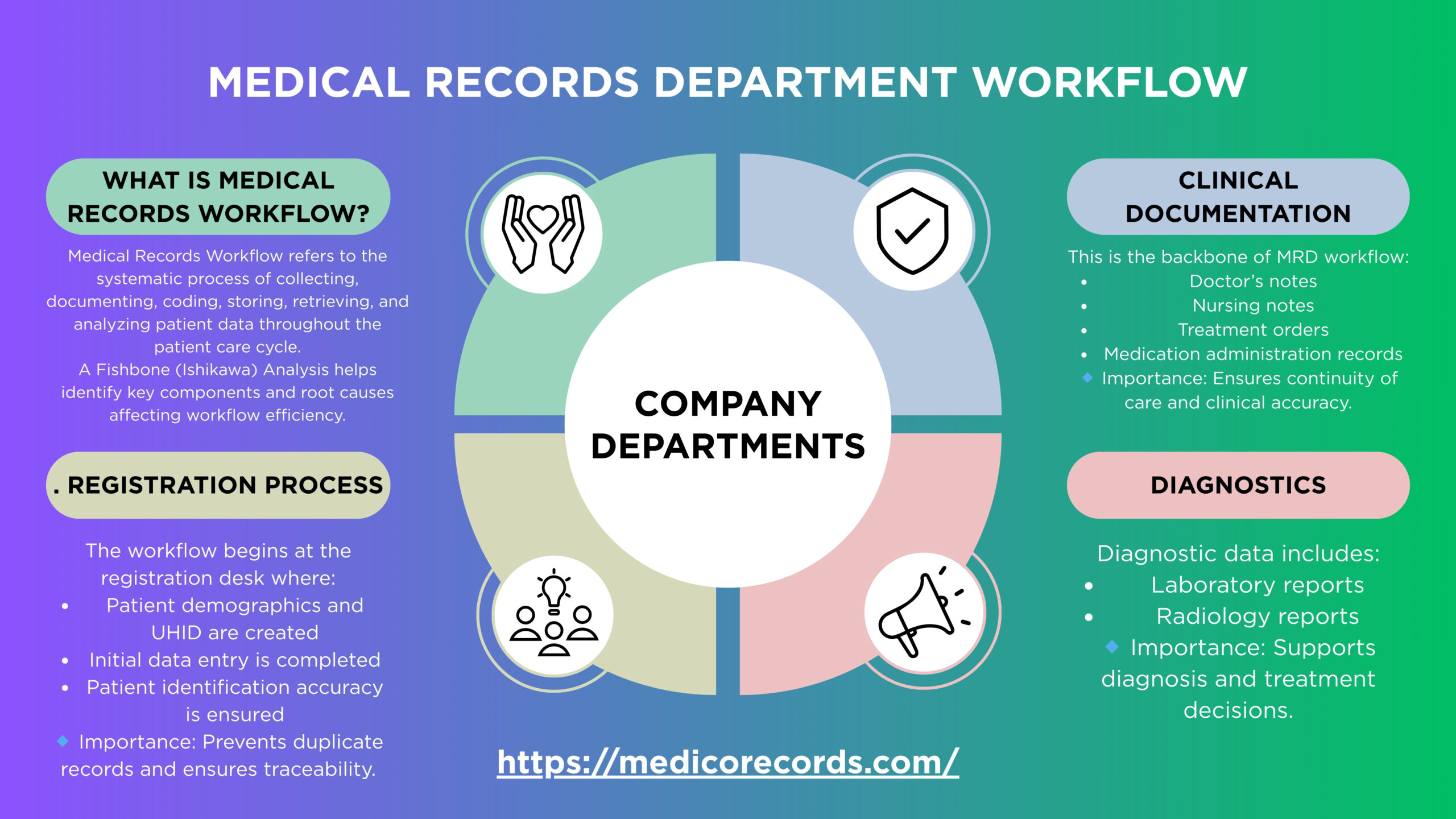
Medical Records Workflow refers to the systematic process of collecting, documenting, coding, storing, retrieving, and analyzing patient data throughout the patient care cycle.
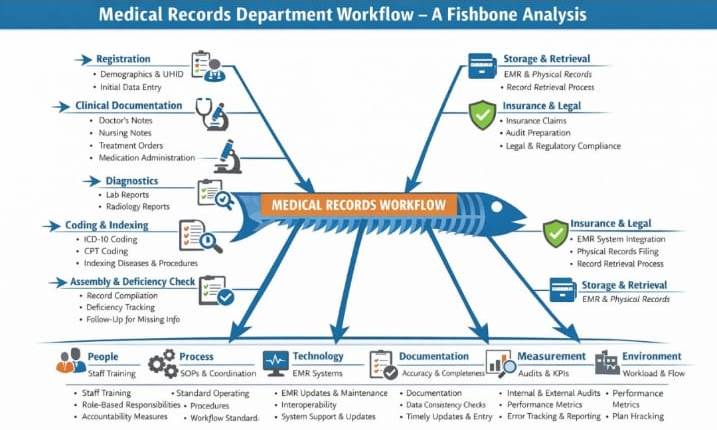
A Fishbone (Ishikawa) Analysis helps identify key components and root causes affecting workflow efficiency.
Key Components of Medical Records Workflow
1. Registration Process
The workflow begins at the registration desk where:
- Patient demographics and UHID are created
- Initial data entry is completed
- Patient identification accuracy is ensured
🔹 Importance: Prevents duplicate records and ensures traceability.
2. Clinical Documentation
This is the backbone of MRD workflow:
- Doctor’s notes
- Nursing notes
- Treatment orders
- Medication administration records
🔹 Importance: Ensures continuity of care and clinical accuracy.
3. Diagnostics
Diagnostic data includes:
- Laboratory reports
- Radiology reports
🔹 Importance: Supports diagnosis and treatment decisions.
4. Coding and Indexing
Medical coding transforms clinical data into standardized formats:
- ICD-10 coding
- CPT coding
- Disease and procedure indexing
🔹 Importance: Essential for billing, insurance claims, and analytics.
5. Assembly and Deficiency Check
Before final storage:
- Record compilation
- Deficiency tracking
- Follow-up for missing information
🔹 Importance: Ensures completeness and compliance with NABH standards.
6. Storage and Retrieval
Records are stored in:
- EMR (Electronic Medical Records)
- Physical files
🔹 Includes:
- Record retrieval process
- Secure storage systems
🔹 Importance: Quick access improves patient care and audits.
7. Insurance and Legal Compliance
Critical functions include:
- Insurance claim processing
- Audit preparation
- Legal and regulatory compliance
🔹 Importance: Protects hospital from legal risks and ensures reimbursement.
Fishbone Analysis Categories in MRD Workflow
🔸 People
- Staff training
- Role-based responsibilities
- Accountability measures
🔸 Process
- SOPs and coordination
- Standard operating procedures
- Workflow standardization
🔸 Technology
- EMR systems
- System updates and maintenance
- Interoperability
🔸 Documentation
- Accuracy and completeness
- Data consistency checks
- Timely updates
🔸 Measurement
- KPIs and audits
- Internal and external audits
- Error tracking and reporting
🔸 Environment
- Workflow design
- Performance monitoring
- Plan tracking
Importance of Medical Records Workflow in Hospitals
- ✅ Enhances patient safety and care quality
- ✅ Supports NABH accreditation compliance
- ✅ Improves billing accuracy and revenue cycle
- ✅ Ensures legal protection
- ✅ Enables data-driven decision making
Common Challenges in MRD Workflow
- Incomplete documentation
- Delay in record submission
- Coding errors
- Poor coordination between departments
- Lack of staff training
Best Practices for Optimizing MRD Workflow
- Implement Electronic Medical Records (EMR)
- Regular staff training programs
- Strict SOP adherence
- Conduct periodic audits and feedback analysis
- Use automation tools for coding and indexing
NABH Compliance and MRD Workflow
As per NABH 6th Edition:
- Documentation must be complete, accurate, and timely
- Records should be secure and confidential
- Retrieval system must be efficient and traceable
Conclusion
A well-structured Medical Records Workflow supported by Fishbone Analysis helps hospitals identify inefficiencies and improve performance. By focusing on people, process, technology, and compliance, healthcare organizations can ensure high-quality patient care and achieve accreditation standards.
FAQs (Frequently Asked Questions)
1. What is MRD in hospitals?
MRD stands for Medical Records Department, responsible for managing patient records.
2. Why is medical record workflow important?
It ensures accurate documentation, legal compliance, and better patient care.
3. What is Fishbone Analysis in healthcare?
It is a tool used to identify root causes of workflow problems.
4. What is ICD-10 coding?
A standardized system for classifying diseases.
5. What are EMR systems?
Electronic Medical Records used for digital patient data management.
6. How does MRD support NABH accreditation?
By maintaining proper documentation and compliance standards.
7. What is deficiency check in MRD?
Identifying missing or incomplete information in records.
8. What are common MRD errors?
Coding errors, incomplete data, and delays.
9. How to improve MRD workflow?
Use EMR, training, SOPs, and audits.
10. What is UHID?
Unique Health Identification number for patients.
11. What is indexing in MRD?
Organizing records for easy retrieval.
12. What is audit in MRD?
Reviewing records for compliance and accuracy.
13. What is role of technology in MRD?
Improves efficiency and data management.
14. What is record retrieval process?
Method to access stored patient records.
15. How does MRD help in insurance claims?
By providing accurate coded data for reimbursement.
Written by:
Mr. Naveen Prajapati is a Medical Records Officer with expertise in hospital documentation, NABH standards, and healthcare data management. He is also pursuing Business Analytics, with a strong focus on data-driven healthcare improvements and quality management systems.