
The Medical Records Department (MRD) plays a vital role in maintaining accurate, complete, and confidential patient data in any healthcare organization. To ensure quality, compliance, and efficiency, various types of audits are conducted within MRD. These audits help identify gaps, improve documentation standards, and ensure adherence to legal and accreditation requirements such as NABH.
In this article, we will explore the different types of audits in MRD, their importance, and how they contribute to better healthcare management.
What is an MRD Audit?
An MRD audit is a systematic review of medical records and related processes to evaluate their accuracy, completeness, and compliance with standards. It ensures that patient records are properly maintained, coded, stored, and retrieved.
Audits also help hospitals maintain transparency, improve patient care, and avoid legal complications.
Importance of MRD Audit
Medical record audits are essential for the following reasons:
- Ensure accurate and complete documentation
- Improve quality of patient care
- Support clinical decision-making
- Maintain legal compliance
- Prepare for accreditation (NABH, JCI)
- Prevent revenue loss due to coding errors
- Enhance data security and confidentiality
Types of Audit in MRD
1. Quantitative Audit
Quantitative audit focuses on checking whether all required documents are present in the patient file.
Key Elements Checked:
- Patient identification details
- Admission and discharge summary
- Consent forms
- Investigation reports
- Treatment sheets
Purpose:
To ensure completeness of records.
Example:
Checking if all forms like consent, case sheet, and discharge summary are available in the file.
2. Qualitative Audit
Qualitative audit evaluates the quality and accuracy of documentation.
Key Focus Areas:
- Legibility of handwriting
- Proper diagnosis documentation
- Completeness of treatment notes
- Clinical justification of treatment
Purpose:
To ensure high-quality patient care documentation.
Example:
Assessing whether the doctor has clearly written diagnosis and treatment plan.
3. Retrospective Audit
Retrospective audit is conducted after the patient has been discharged.
Features:
- Review of completed records
- Identification of documentation gaps
- Analysis of treatment patterns
Purpose:
To evaluate overall record quality and improve future performance.
Example:
Reviewing discharge files monthly for missing signatures or incomplete notes.
4. Concurrent Audit
Concurrent audit is conducted while the patient is still admitted in the hospital.
Features:
- Real-time monitoring
- Immediate correction of errors
- Continuous evaluation
Purpose:
To ensure documentation is correct during patient care.
Example:
Checking daily progress notes during patient stay.
5. Clinical Audit
Clinical audit focuses on the clinical aspects of patient care and treatment.
Key Focus Areas:
- Diagnosis accuracy
- Treatment appropriateness
- Clinical outcomes
Purpose:
To improve clinical performance and patient safety.
Example:
Comparing treatment protocols with standard guidelines.
6. Coding and Billing Audit
This audit ensures correct medical coding and billing practices.
Key Focus Areas:
- ICD and CPT coding accuracy
- Proper billing charges
- Avoidance of fraud
Purpose:
To prevent revenue leakage and ensure compliance.
Example:
Checking if diagnosis codes match treatment provided.
7. Legal Audit
Legal audit ensures that all records comply with legal and medico-legal requirements.
Key Focus Areas:
- Proper consent documentation
- Medico-legal case records
- Record retention policies
Purpose:
To protect hospital from legal issues.
Example:
Ensuring informed consent is properly signed before procedures.
8. Internal Audit
Internal audit is conducted by the hospital’s own audit team.
Features:
- Regular monitoring
- Continuous improvement
- Staff training
Purpose:
To maintain internal quality standards.
9. External Audit
External audit is conducted by outside agencies such as NABH or government authorities.
Features:
- Independent evaluation
- Accreditation assessment
- Compliance verification
Purpose:
To ensure hospital meets national and international standards.
10. Data Quality Audit
This audit focuses on the accuracy and integrity of data stored in hospital systems.
Key Focus Areas:
- Data entry errors
- Duplicate records
- Missing information
Purpose:
To improve data reliability for analysis and reporting.
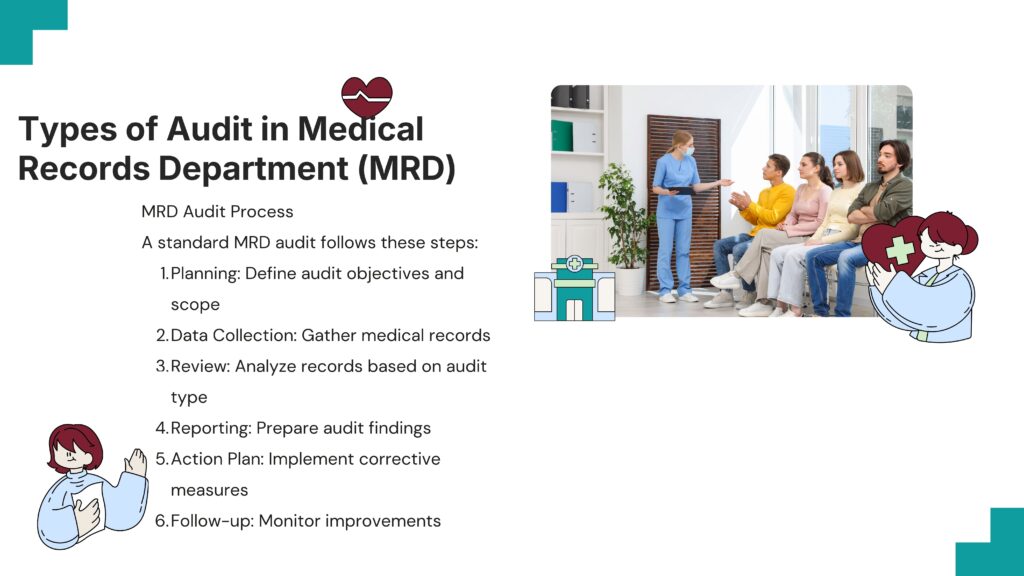
MRD Audit Process
A standard MRD audit follows these steps:
- Planning: Define audit objectives and scope
- Data Collection: Gather medical records
- Review: Analyze records based on audit type
- Reporting: Prepare audit findings
- Action Plan: Implement corrective measures
- Follow-up: Monitor improvements
Common Challenges in MRD Audit
- Incomplete documentation
- Poor handwriting
- Lack of staff training
- Resistance to change
- Time constraints
Best Practices for Effective MRD Audit
- Regular staff training programs
- Use of Electronic Medical Records (EMR)
- Standardized documentation formats
- Continuous monitoring
- Strong leadership support
Conclusion
Audits in the Medical Records Department are essential for maintaining high standards of healthcare documentation. Different types of audits, such as quantitative, qualitative, clinical, and coding audits, help ensure accuracy, compliance, and efficiency.
By implementing a structured audit system, hospitals can improve patient care, reduce errors, and achieve accreditation standards like NABH. Regular MRD audits not only enhance operational efficiency but also strengthen the overall healthcare delivery system.
FAQs
Q1. What is the main purpose of MRD audit?
To ensure accuracy, completeness, and compliance of medical records.
Q2. What is the difference between quantitative and qualitative audit?
Quantitative checks completeness, while qualitative checks quality of documentation.
Q3. What is concurrent audit?
Audit conducted during patient treatment.
Q4. Why is coding audit important?
It prevents billing errors and revenue loss.
Q5. How often should MRD audits be conducted?
Regularly—monthly, quarterly, or as per hospital policy.