Introduction
Healthcare quality and patient safety are critical in today’s medical environment. In India, the National Accreditation Board for Hospitals & Healthcare Providers (NABH) plays a vital role in ensuring hospitals meet high standards of care.
Hospitals aiming to improve quality often face a key question:
👉 Should we go for NABH Full Accreditation or Entry-Level Accreditation?
This guide provides a complete comparison, helping hospitals choose the right path toward accreditation.
What is NABH Accreditation?
NABH is a constituent board of the Quality Council of India (QCI). It sets benchmarks for healthcare organizations to ensure patient safety, quality treatment, and operational excellence.
There are two main types of NABH certifications:
- Entry-Level Accreditation
- Full Accreditation
What is NABH Entry-Level Accreditation?
Entry-Level Accreditation is designed for small and medium hospitals that are beginning their quality journey.
Key Features:
- Basic quality standards (around 50–60 standards)
- Easier implementation
- Shorter preparation time (3–6 months)
- Validity: 2 years
Purpose:
👉 To help hospitals start their quality improvement process
Benefits:
- Improves basic patient safety
- Enhances hospital credibility
- Acts as a stepping stone toward full accreditation
What is NABH Full Accreditation?
Full Accreditation is a comprehensive certification covering all aspects of hospital operations.
Key Features:
- Detailed standards (600+ objective elements)
- Covers clinical, administrative, and legal areas
- Requires strong documentation and processes
- Validity: 4 years
Purpose:
👉 To ensure complete quality excellence and global-level healthcare standards
Benefits:
- Higher trust among patients
- Better insurance and empanelment opportunities
- International recognition
- Improved hospital efficiency
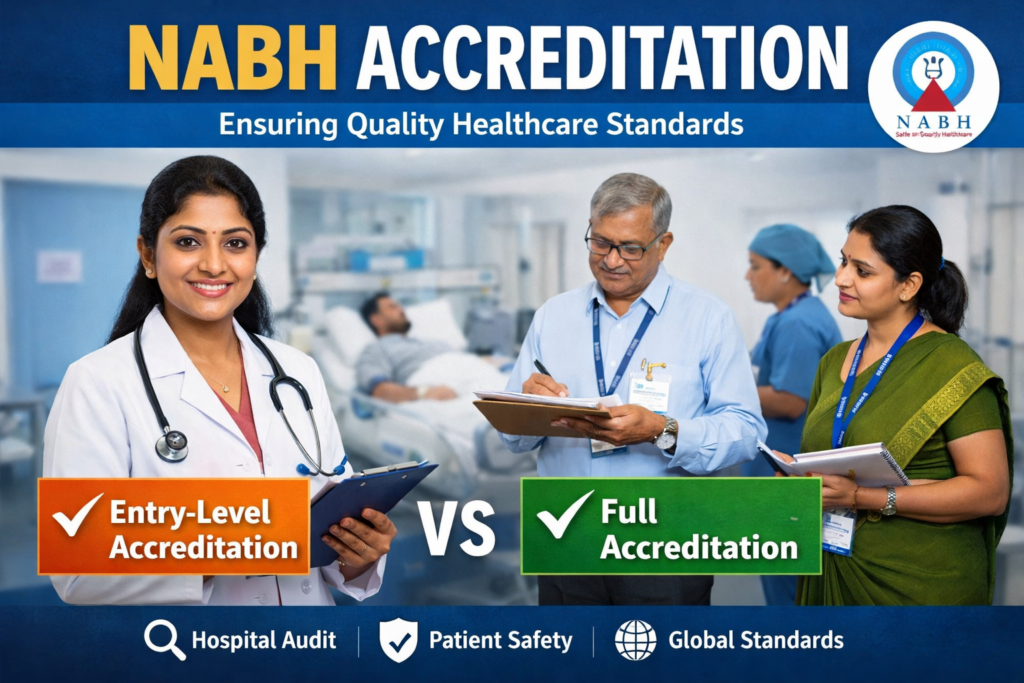
NABH Full vs Entry-Level Accreditation (Comparison Table)
| Criteria | Entry-Level Accreditation | Full Accreditation |
|---|---|---|
| Standards | Basic (50–60) | Advanced (600+) |
| Preparation Time | 3–6 months | 12–18 months |
| Validity | 2 years | 4 years |
| Complexity | Low | High |
| Cost | Lower | Higher |
| Documentation | Minimal | Extensive |
| Suitable For | Small hospitals | Large/multi-specialty hospitals |
| Goal | Start quality journey | Achieve excellence |
Key Differences Explained
1. Level of Standards
Entry-level focuses on basic safety, while full accreditation ensures end-to-end quality management.
2. Documentation
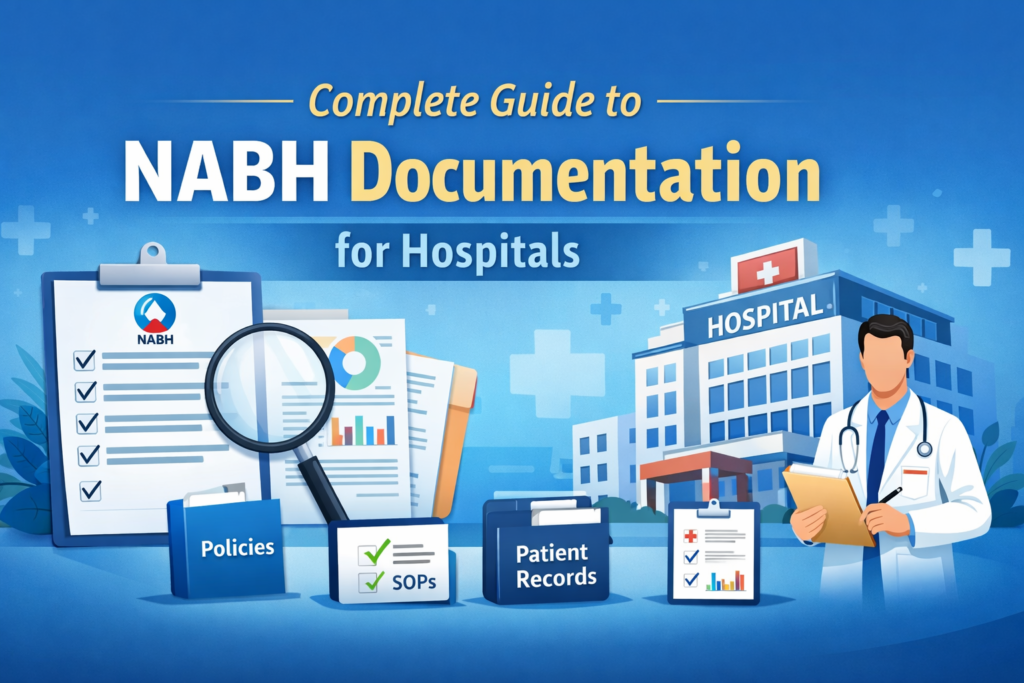
Full accreditation requires:
- SOPs (Standard Operating Procedures)
- Policies
- Clinical protocols
Entry-level requires minimal documentation.
3. Time & Effort
Entry-level is quicker and easier.
Full accreditation demands dedicated quality teams and audits.
4. Cost Factor
Entry-level is budget-friendly, whereas full accreditation involves:
- Training costs
- Consultant fees
- Infrastructure upgrades
Accreditation Process (Step-by-Step)
Step 1: Application
Register on NABH portal
Step 2: Self-Assessment
Evaluate current hospital practices
Step 3: Documentation
Prepare policies, SOPs, and manuals
Step 4: Training
Train staff on quality standards
Step 5: Internal Audit
Identify gaps and improve
Step 6: External Assessment
NABH assessors visit hospital
Step 7: Certification
Hospital receives accreditation
Which One Should You Choose?
Choose Entry-Level Accreditation if:
- You are a small hospital (10–50 beds)
- New to quality standards
- Limited budget
- Want quick certification
Choose Full Accreditation if:
- You have established systems
- Want long-term growth
- Need insurance empanelment
- Aim for international standards
Advantages of NABH Accreditation
- Improved patient safety
- Standardized treatment protocols
- Better staff accountability
- Increased patient trust
- Higher revenue opportunities
- Compliance with legal requirements
Challenges in NABH Accreditation
- Staff resistance to change
- Documentation burden
- Cost and resource allocation
- Continuous monitoring requirement
👉 However, these challenges lead to long-term benefits.
Future of NABH Accreditation in India
With digital healthcare, EMR systems, and AI integration, NABH standards are evolving rapidly. Hospitals with accreditation will have a competitive advantage in:
- Insurance partnerships
- Medical tourism
- Government schemes
Conclusion
NABH Accreditation is not just a certificate—it is a commitment to quality healthcare.
- Entry-Level Accreditation → Starting point
- Full Accreditation → Excellence and global standards
👉 The best approach:
Start with Entry-Level → Upgrade to Full Accreditation
This ensures sustainable growth and better patient outcomes.
FAQs (Frequently Asked Questions)
1. What is NABH Entry-Level Accreditation?
It is a basic certification for hospitals starting their quality journey.
2. What is NABH Full Accreditation?
It is a comprehensive certification covering all hospital operations.
3. How long does NABH accreditation take?
Entry-level: 3–6 months
Full: 12–18 months
4. What is the validity of NABH accreditation?
Entry-level: 2 years
Full: 4 years
5. Which is better: Entry-Level or Full Accreditation?
Full accreditation is better, but entry-level is ideal for beginners.
6. Is NABH accreditation mandatory?
No, but it is highly recommended.
7. What is the cost of NABH accreditation?
Depends on hospital size and type of accreditation.
8. Can small hospitals apply for full accreditation?
Yes, but it requires more preparation.
9. Does NABH improve hospital revenue?
Yes, through trust, insurance tie-ups, and better services.
10. What are the documents required?
Policies, SOPs, clinical protocols, and records.
11. What is the role of internal audit?
To identify gaps before final assessment.
12. Can accreditation be renewed?
Yes, after expiry.
13. Is NABH recognized internationally?
Yes, it follows global standards.
14. Do government hospitals apply for NABH?
Yes, many government hospitals are NABH accredited.
15. What is the first step for NABH accreditation?
Register on the
NABH official portal.
Written By
Naveen Prajapati is a healthcare professional specializing in Medical Records Management and Business Analytics. With experience in hospital quality systems and NABH standards, he helps healthcare organizations improve patient care and operational efficiency.