Introduction
In the healthcare industry, quality and patient safety are critical components of service delivery. The National Accreditation Board for Hospitals & Healthcare Providers (NABH) plays a vital role in maintaining healthcare standards in India. Among its various standards, IMS-10 (Information Management System) is one of the most important chapters that ensures proper handling of patient data, documentation, and confidentiality.
This article provides complete details about IMS-10 NABH standards and explains its role during NABH assessment, helping hospitals and Medical Records Departments (MRD) prepare effectively for accreditation.
What is IMS-10 in NABH?
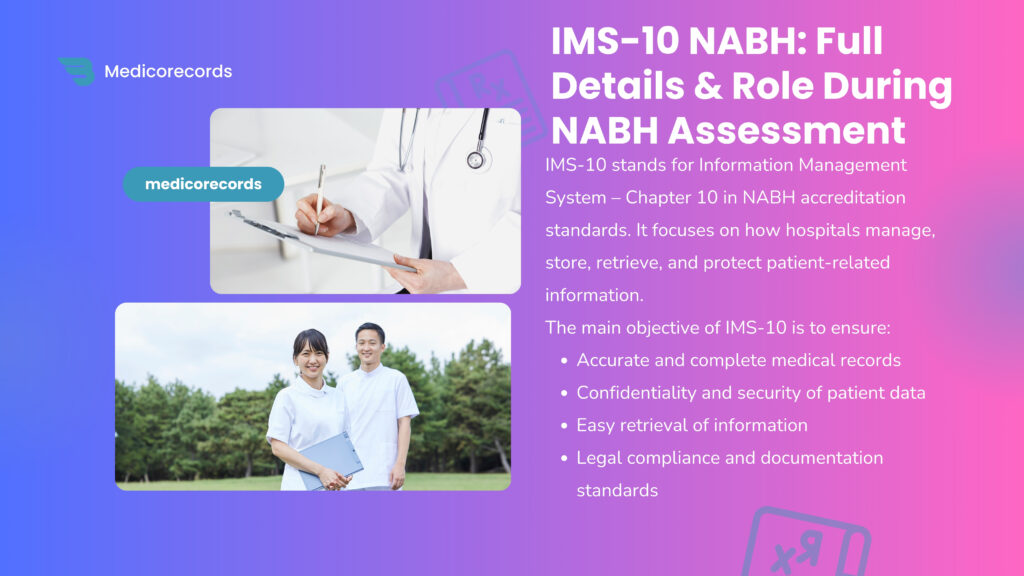
IMS-10 stands for Information Management System – Chapter 10 in NABH accreditation standards. It focuses on how hospitals manage, store, retrieve, and protect patient-related information.
The main objective of IMS-10 is to ensure:
- Accurate and complete medical records
- Confidentiality and security of patient data
- Easy retrieval of information
- Legal compliance and documentation standards
Key Objectives of IMS-10
The IMS chapter ensures that hospitals maintain:
1. Data Accuracy and Completeness
All patient records must be complete, legible, and updated regularly.
2. Confidentiality and Security
Patient information should be protected from unauthorized access.
3. Timely Availability of Records
Medical records must be available when required for treatment or audits.
4. Standardized Documentation
Uniform formats and protocols should be followed for documentation.
Major Elements of IMS-10 NABH
1. Document Control System
Hospitals must have a proper system for:
- Document creation
- Approval
- Version control
- Periodic review
2. Medical Records Management
Includes:
- OPD and IPD records
- Discharge summaries
- Investigation reports
- Consent forms
3. Coding and Indexing
- Use of ICD codes (International Classification of Diseases)
- Proper indexing for easy retrieval
4. Data Security and Confidentiality
- Password-protected systems
- Restricted access
- Confidentiality agreements for staff
5. Record Retention Policy
Hospitals must define how long records are stored:
- OPD records: Minimum 3 years
- IPD records: Minimum 3–5 years (as per policy)
6. Electronic Medical Records (EMR)
- Implementation of digital systems
- Backup and recovery mechanisms
- Audit trails
Role of IMS-10 During NABH Assessment
During NABH assessment, IMS-10 plays a crucial role. Assessors evaluate how effectively the hospital manages its information system.
1. Document Verification
Assessors check:
- Policies and procedures
- SOPs (Standard Operating Procedures)
- Record formats
2. Medical Record Audit
They review:
- Completeness of records
- Accuracy of documentation
- Timeliness of entries
3. Staff Awareness
Staff members are asked questions like:
- How do you maintain confidentiality?
- What is your document control process?
4. Data Security Check
Assessors verify:
- Access control systems
- Password policies
- IT security measures
5. Record Retrieval Test
Hospitals may be asked to:
- Retrieve patient files quickly
- Show old records
- Demonstrate indexing system
Importance of IMS-10 for Hospitals
1. Improves Patient Safety
Accurate records help doctors make better decisions.
2. Legal Protection
Proper documentation protects hospitals in medico-legal cases.
3. Better Communication
Ensures smooth communication between departments.
4. Quality Improvement
Helps in audits and continuous improvement.
Role of Medical Records Department (MRD)
The MRD plays a central role in implementing IMS-10 standards.
Key Responsibilities:
- Maintaining patient files
- Ensuring completeness of records
- Coding and indexing
- Handling medico-legal cases
- Ensuring confidentiality
- Supporting audits
Common Non-Conformities in IMS-10
During assessment, hospitals often face issues like:
- Incomplete medical records
- Missing signatures
- Improper consent forms
- Lack of document control
- Poor record storage
- No data backup system
Tips to Prepare for IMS-10 Assessment
1. Conduct Internal Audits
Regular audits help identify gaps.
2. Train Staff
Ensure all staff understand documentation standards.
3. Maintain Checklists
Use MRD checklists for completeness.
4. Implement EMR Properly
Ensure digital systems are secure and functional.
5. Update Policies Regularly
Keep SOPs updated as per NABH guidelines.
IMS-10 and Digital Transformation
With increasing use of technology, IMS-10 also emphasizes:
- Electronic Medical Records (EMR)
- Data analytics
- Cloud storage with security
- Telemedicine documentation
Conclusion
IMS-10 is a backbone of NABH accreditation, ensuring that hospitals maintain high standards in information management. A well-implemented IMS system not only helps in accreditation but also improves patient care, legal compliance, and operational efficiency.
Hospitals that focus on strong documentation practices and data security can easily succeed in NABH assessments and maintain long-term quality standards.
FAQs (15 Frequently Asked Questions)
1. What is IMS-10 in NABH?
IMS-10 is the Information Management System chapter in NABH that focuses on medical records and data management.
2. Why is IMS-10 important?
It ensures accurate documentation, patient safety, and legal compliance.
3. What does NABH assessor check in IMS-10?
They check documentation, record completeness, confidentiality, and data security.
4. What is the role of MRD in IMS-10?
MRD manages medical records, coding, indexing, and audit support.
5. What is document control in NABH?
It ensures proper creation, approval, and updating of documents.
6. How long should records be retained?
Usually 3–5 years depending on hospital policy.
7. What is EMR in IMS-10?
Electronic Medical Records system used for digital documentation.
8. What is medical record audit?
Review of patient records to ensure completeness and accuracy.
9. What are common IMS-10 errors?
Incomplete records, missing signatures, poor storage.
10. Is confidentiality mandatory in NABH?
Yes, patient data must be strictly confidential.
11. What is ICD coding?
International system for disease classification used in records.
12. How to prepare for IMS-10 assessment?
Internal audits, staff training, and documentation improvement.
13. What is record retrieval system?
System to quickly find patient records when needed.
14. Is digital record mandatory?
Not mandatory but highly recommended.
15. How does IMS-10 improve hospital quality?
It ensures standardization, safety, and efficient data management.
IMS-10 NABH Full Details & Role in Assessment | Complete Guide for Hospitals
Learn complete details of IMS-10 NABH standards, its role during NABH assessment, MRD responsibilities, documentation, and FAQs for hospital accreditation success.
Written By:
Naveen Prajapati
Medical Records Officer & Business Analytics Professional